

Malta Workforce Market Overview & Labour Challenges
As of 1 January 2025, Malta’s population was estimated at just over 600,000 residents, reflecting ongoing growth driven largely by net migration.The economy continues to expand, but this rapid population and labour market growth has contributed to a tight workforce environment.According to Malta’s National Statistics Office (NSO), there were 9,158 job vacancies in Q2 2025, representing a 13.2 % increase compared with the same period in 2024.During the same quarter, the job vacancy rate — the share of jobs unfilled across all posts — stood at 3.2 %, up 0.2 percentage points year-on-year.By Q3 2025, vacancies had risen further to 9,798, with the job vacancy rate increasing to 3.4 %, underscoring intensifying labour demand.Malta’s small population restricts the number of qualified candidates available.Labour shortages extend recruitment time, especially in high-demand sectors like IT, hospitality, and construction.Employers often lose candidates to competitors offering better packages or faster hiring.High vacancy levels, especially in the private sector and small enterprises, indicate persistent manpower shortages, as employers struggle to recruit sufficient skilled and unskilled workers.
Malta Labour crisis rate (Yearly)
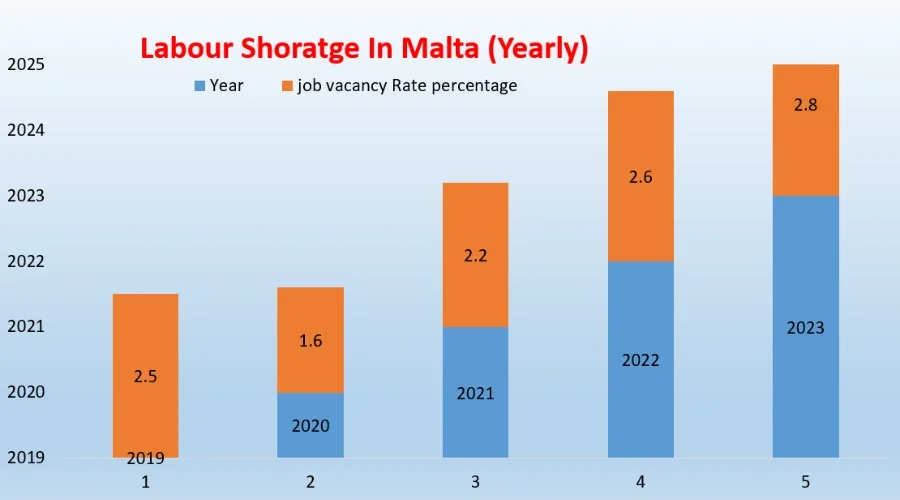
Malta’s job vacancy rate data from 2015 to 2024 shows an important story about the country’s evolving labour market. The year-wise job vacancy rates show clear shifts in labour market conditions between 2019 and 2023. In 2019, a vacancy rate of 2.5% reflected strong labour demand in a growing economy. This dropped sharply to 1.6% in 2020, indicating reduced hiring activity due to economic disruption and uncertainty. As recovery began, the vacancy rate increased to 2.2% in 2021, signalling a gradual return of employer demand.
Malta Labour crisis rate (Industry wise)
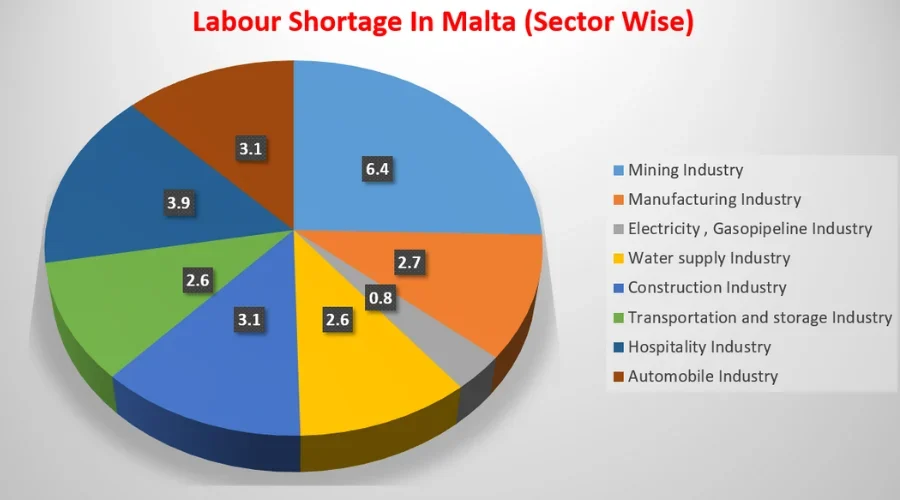
Malta faces labour shortages across major sectors. Mining leads with 6.4%, followed by hospitality 3.9%, construction and automobile 3.1%. Manufacturing, transportation, and water supply report around 2.6–2.7%, while electricity and gas show 0.8%. These shortages highlight Malta’s growing reliance on foreign workers to sustain economic and industrial growth today now. Overall, these trends highlight Malta’s strong dependence on foreign workers to sustain economic growth and maintain industrial productivity.
Malta Labour crisis rate (Job profile wise)
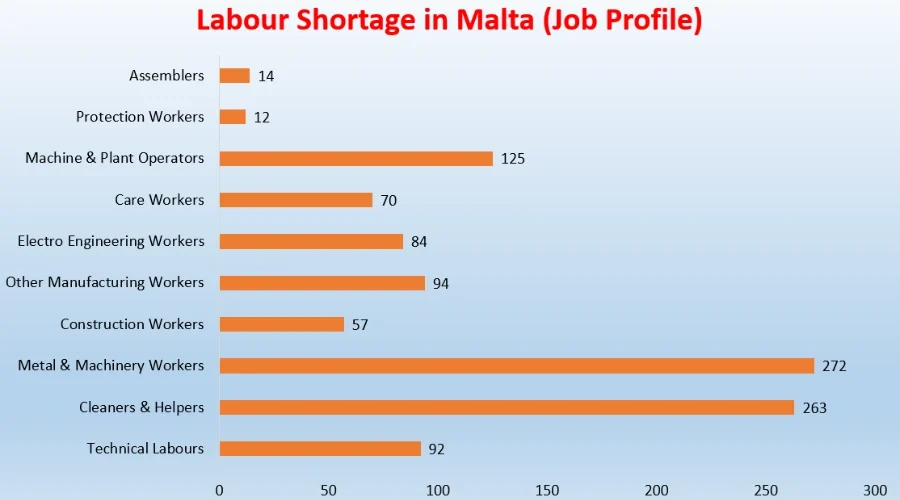
The skill-wise vacancy data for Malta highlights shortages across sectors, like Metal and machinery workers (272 vacancies) and cleaners and helpers (263 vacancies) show the highest demand, emphasizing gaps in technical and support roles. Machine and plant operators (125) and technical labour (92) also show scarcity, underlining the need for skilled personnel in industrial operations. Specialized roles, including electro-engineering workers (84), other manufacturing workers (94), and care workers (70).
Employer Pain Points in Malta’s Labour Market

Limited Candidate Pool: Malta’s small population limits the number of qualified local candidates available for each job vacancy.High Time-to-Hire: Labour shortages prolong recruitment timelines, particularly in sectors with consistently high demand.Skills Mismatch During Screening: Many applicants lack the required technical skills or relevant practical experience, knowledge, and industry exposure, resulting in repeated screening and higher rejection rates.Intense Competition for Talent: Employers often lose candidates to competitors offering faster decisions or more attractive compensation.Dependence on Foreign Recruitment: Companies must recruit internationally to fill gaps, increasing complexity in hiring and onboarding.Work Permit & Compliance Delays: Immigration and regulatory procedures slow down the hiring of non-local workers.High Recruitment Costs: Increase the Budget on hiring international workers
How Setu Global Group Helps Your Business

Legally Registered Local Presence: Setu Global Group operates in Latvia through its legally registered entity Setu Global Group SIA, allowing employers to work with a locally compliant recruitment partner that understands national labour and immigration regulations.End-to-End Legal Documentation: All employment and immigration documentation is handled through authorised legal professionals, ensuring contracts, work permits, residence applications, and compliance filings are processed correctly and on time.Work Permit & Visa Process Management: Setu Global Group coordinates directly with legal experts and authorities to manage: Work permit applications, Residence visa documentation, Labour office approvals, Embassy coordination, This reduces employer delays and administrative burden.Compliance with Government Norms: Every worker supplied meets local labour law standards, employment contract rules, and immigration compliance requirements, protecting employers from legal risks and penalties.
Industries We Serve Globally
We provides skilled workers across the following industries:
Construction Industry
Manufacturing Industry
Automobile Industry
Logistics & Warehousing
Hospitality Industry
Refining Industry
Agriculture Industry
Utilities & Infrastructure
Plastic Industry
Skilled Profiles We Provide
We provides skilled workers across the following industries:
Construction Industry
Manufacturing Industry
Automobile Industry
Logistics & Warehousing
Hospitality Industry
Refining Industry
Agriculture Industry
Utilities & Infrastructure
Plastic Industry
Available Employment models
We provides skilled workers across the following industries:
Construction Industry
Manufacturing Industry
Automobile Industry
Logistics & Warehousing
Hospitality Industry
Refining Industry
Agriculture Industry
Utilities & Infrastructure
Plastic Industry
Partner with Setu Global group
Facing labour shortages or expansion challenges in Romania?
Setu Global Group delivers reliable, compliant, and scalable Indian manpower solutions that support uninterrupted operations and long-term growth