

Czench Republic Workforce Market Overview
There were approximately 245,573 job vacancies for about 284,430 unemployed individuals in 2024, meaning vacancies approached the number of people available to fill them rather than being far fewer.Approximately 66 % of Czech employers reported difficulties in finding qualified workers in a recent nationwide survey (2023).Employers reported around ~96,000 job vacancies at the end of May 2025, with about 3.3 job seekers per vacancy.Earlier in 2025, approximately 88,000–92,000 vacancies were registered monthly by the Czech Labour Office.As of 1 January 2024, the population of the Czech Republic was approximately 10.909 million people, according to official data published by the Czech Statistical Office for the end of 2024 which reflects the population at the start of that year.In 2023, more than 5.2 million people were active on the labour market in Czechia. The employment rate was 75.1%, 4.7 percentage points higher than the EU27 average and almost identical to 2018. In 2023, for women, the employment rate was 68.2%, for men, the employment rate was 81.6%, and for youth, the employment rate was 25.5%, with men and women having rates higher than the EU average and with only youth having a rate lower than the EU average.In 2023, 93.6% of the active workforce were from Czechia, 2.7% from other EU Member States and 3.7 from third countries. In the EU27, as of 2023, the highest proportion of the workforce comes from the respective country (85% on average), while on average a smaller portion is from foreign countries (4.3% from other EU Member States, and 10.5% from third countries).In 2022, most employees worked in manufacturing (30.9%), followed by wholesale and retail trade; repair of motor vehicles and motorcycles (17.9%), construction (9.8%) and professional, scientific and technical activities (7.5%). In terms of number of enterprises, most can be found in wholesale and retail trade; repair of motor vehicles and motorcycles (18.4%), professional, scientific and technical activities (17.2%), and construction (16%).
Czech Republic Labour crisis rate (Yearly)
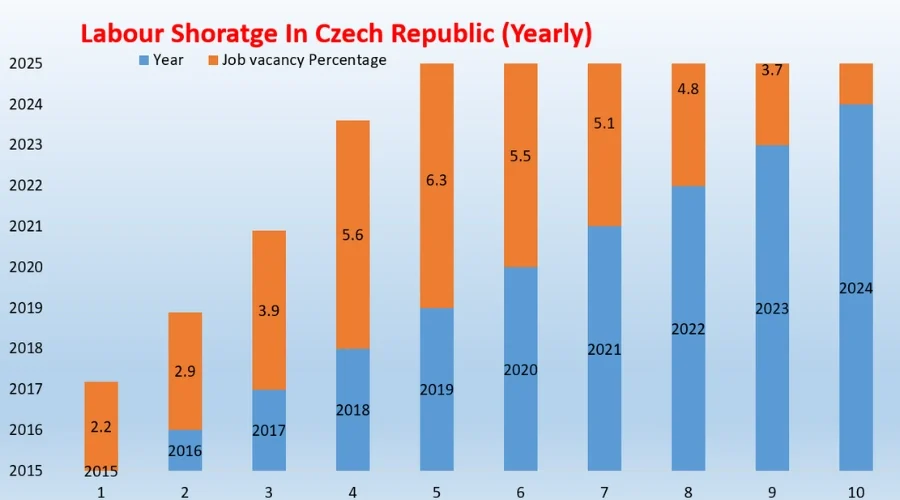
Czench’s job vacancy rate data from 2015 to 2024 shows an important story about the country’s evolving labour market. The job vacancy rate in the Czech Republic from 2015 to 2024 reflects the country’s evolving labour market dynamics. Starting at 2.2% in 2015, vacancies steadily increased each year, reaching a peak of 6.3% in 2019, highlighting strong economic growth, expanding industries, and rising demand for skilled and semi-skilled workers. In 2020, the rate declined to 5.5%, reflecting pandemic-related economic disruptions
Czech republic Labour crisis rate (Industry wise)
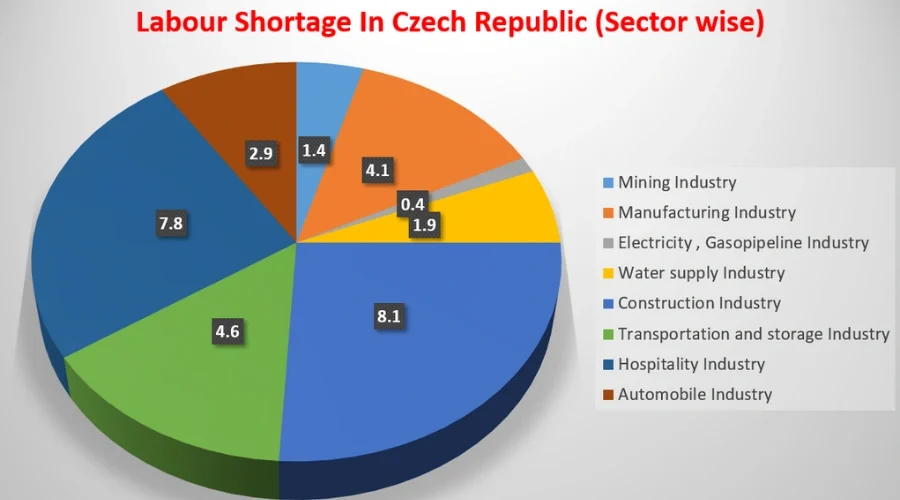
The sector-wise job vacancy rate data (2019–2023) reveals clear differences in labor demand across industries. Administrative and support services, real estate, and construction consistently recorded the highest vacancy rates, indicating sustained shortages of operational and field-based workers despite gradual declines after 2020. Manufacturing, transportation, and accommodation services showed moderate but stable vacancy levels, reflecting ongoing demand for skilled and semi-skilled labor.
Czech Republic Labour crisis rate (Job profile wise)
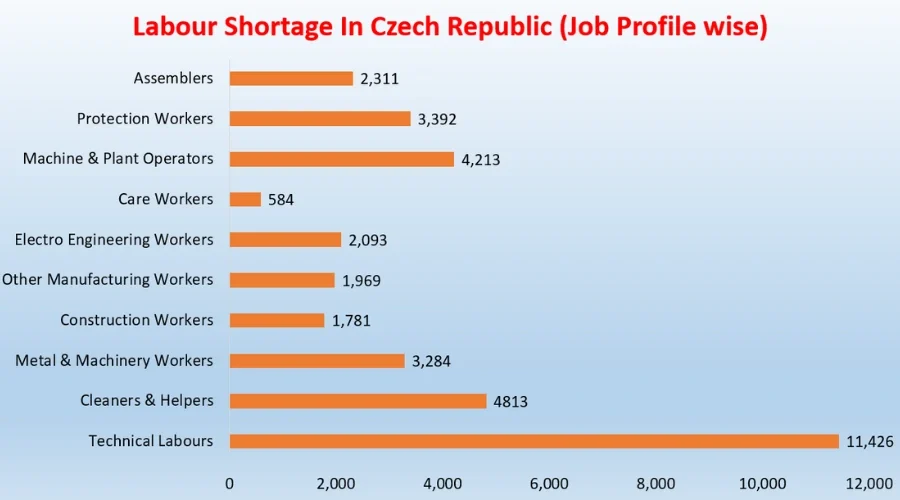
The skill-wise vacancy data highlights a significant manpower shortage across multiple occupational categories. Technical labour roles face the highest scarcity with 11,426 vacancies, indicating strong demand for skilled trades. Machine and plant operators (4,213) and cleaners and helpers (4,813) also show substantial gaps, reflecting pressure in both industrial and support functions. Shortages are evident in core industrial roles such as metal and machinery workers (3,284), electro-engineering workers (2,093), assemblers (2,311).
Employer Pain Points in Czech Labour Market

Low Unemployment Rate – With jobless rates near 3%, Employers have a small number of people looking for work to pick from.High Job Vacancies – A large number of unfilled positions remain open, showing that labour demand exceeds supply.Skill Mismatch – Available workers often lack the specific technical or vocational skills required by employers.Ageing Workforce – More workers are retiring than entering the labour market, reducing the overall labour supply.Manufacturing and Construction Shortages – Key sectors such as manufacturing and construction face persistent shortages of skilled workers.Wage Inflation Pressure – Labour scarcity forces employers to raise wages and benefits, increasing operating costs.Longer Recruitment Cycles – Employers experience extended hiring timelines due to the limited availability of suitable candidates.
How Setu Global Group Helps Your Business

Legally Registered Local Presence: Setu Global Group operates in Latvia through its legally registered entity Setu Global Group SIA, allowing employers to work with a locally compliant recruitment partner that understands national labour and immigration regulations.End-to-End Legal Documentation: All employment and immigration documentation is handled through authorised legal professionals, ensuring contracts, work permits, residence applications, and compliance filings are processed correctly and on time.Work Permit & Visa Process Management: Setu Global Group coordinates directly with legal experts and authorities to manage: Work permit applications, Residence visa documentation, Labour office approvals, Embassy coordination, This reduces employer delays and administrative burden.Compliance with Government Norms: Every worker supplied meets local labour law standards, employment contract rules, and immigration compliance requirements, protecting employers from legal risks and penalties.
Industries We Serve Globally
We provides skilled workers across the following industries:
Construction Industry
Manufacturing Industry
Automobile Industry
Logistics & Warehousing
Hospitality Industry
Refining Industry
Agriculture Industry
Utilities & Infrastructure
Plastic Industry
Skilled Profiles We Provide
We provides skilled workers across the following industries:
Construction Industry
Manufacturing Industry
Automobile Industry
Logistics & Warehousing
Hospitality Industry
Refining Industry
Agriculture Industry
Utilities & Infrastructure
Plastic Industry
Available Employment models
We provides skilled workers across the following industries:
Construction Industry
Manufacturing Industry
Automobile Industry
Logistics & Warehousing
Hospitality Industry
Refining Industry
Agriculture Industry
Utilities & Infrastructure
Plastic Industry
Partner with Setu Global group
Facing labour shortages or expansion challenges in Romania?
Setu Global Group delivers reliable, compliant, and scalable Indian manpower solutions that support uninterrupted operations and long-term growth