

Slovenia Workforce Market Overview & Labour Challenges
Slovenia’s population stands at about 2.13 million (mid-2025), with 15.1 % foreign-born residents, reflecting growing reliance on inward migration to support the workforce. In 2025, in Slovenia, the occupational groups with the highest occurrence of shortage occupations were: building and related trades workers (excluding electricians), metal, machinery and related trades workers and health professionals. Slovenia is currently facing a tight labour market with persistent employee scarcity, especially in sectors like manufacturing, construction, healthcare and services, where employers increasingly report shortages of qualified workers. In mid-2025 business survey data showed that around 20-25 % of firms cited labour shortage as a major constraint on production, significantly above long-term averages. Demographic trends compound the scarcity: Slovenia’s working-age population is declining and cannot fully meet labour demand, pushing employers to seek foreign workers through bilateral agreements and work permits.
Slovenia Labour crisis rate (Yearly)
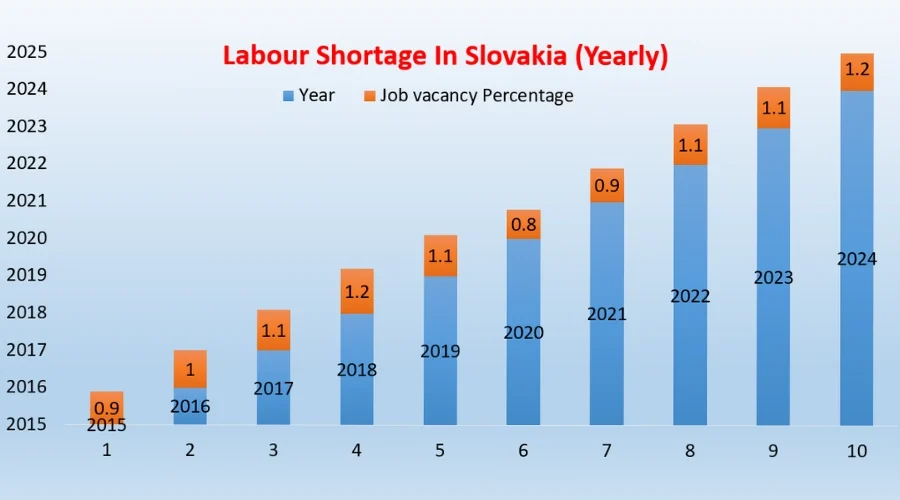
From a research perspective, Slovakia’s job vacancy data from 2015 to 2024 highlights important shifts in labor market demand. The vacancy rate rose steadily from 0.9% in 2015 to 1.2% in 2018, indicating strong economic expansion and increasing hiring pressure on employers. A slight moderation occurred in 2019 (1.1%), before a significant drop to 0.8% in 2020 due to the COVID-19 pandemic and reduced business activity. As the economy recovered, the rate improved to 0.9% in 2021 and 1.1% in 2022, showing renewed recruitment demand. Stability continued in 2023 (1.1%), 2025 (1.2%) rised refer the graph .
Labor shortage in slovkia (sector wise)
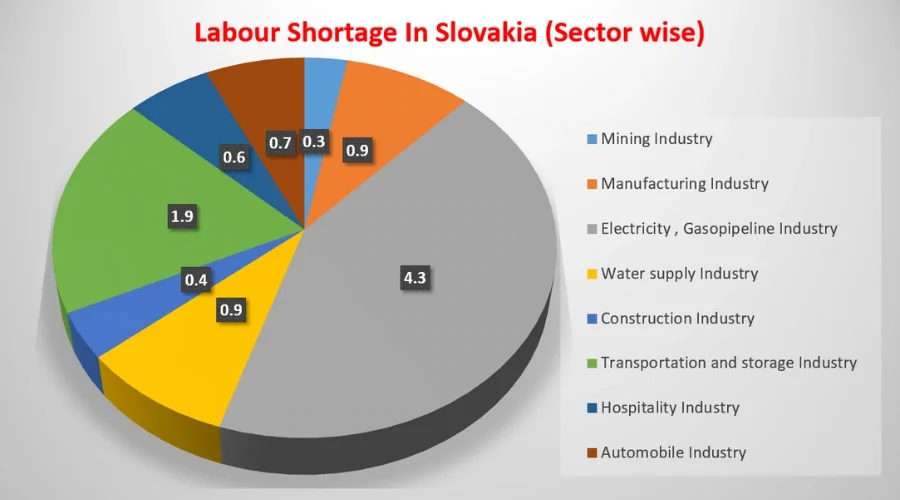
Slovakia’s job vacancy rates reveal where labor shortages are most severe. The Electricity, Gas, and Pipeline sector (4.3%) faces the strongest pressure, reflecting a shortage of highly skilled technical workers and an aging workforce. Transportation and storage (1.9%) also shows significant gaps, driven by growing logistics demand and a lack of drivers and warehouse staff. Moderate shortages appear in all vital to Slovakia’s industrial economy but struggling to attract both skilled and entry-level workers. Meanwhile, Hospitality (0.6%), Construction (0.4%), and Mining (0.3%) report lower rates, as compared to others.
labor shortage in slovakia (Job profile wise)
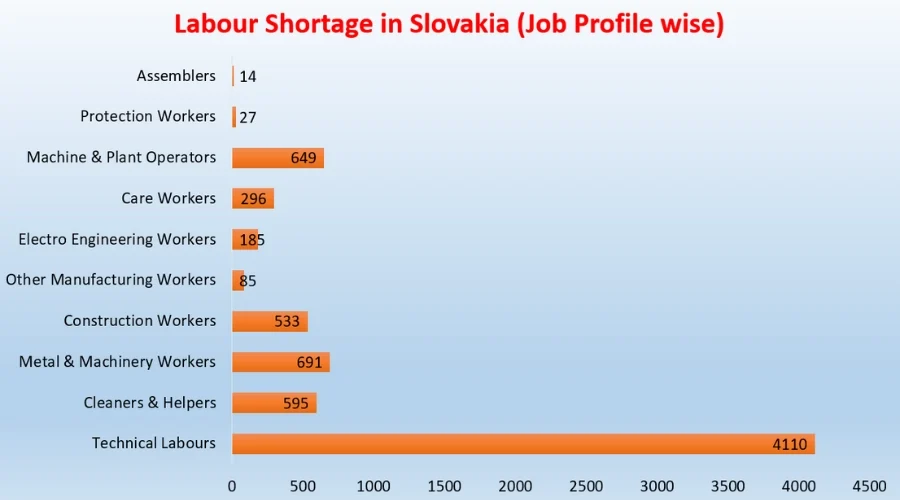
Looking at Slovakia’s labor market from a skills-based perspective, the vacancy data highlights serious workforce shortages in several key occupations. The highest demand is for Technical Labourers (4,110 vacancies), showing a major skills gap in industrial and production roles. Strong demand is also visible for Metal and Machinery Workers (691), Machine and Plant Operators (649), and Construction Workers (533) — all essential to Slovakia’s manufacturing and infrastructure sectors. Service roles such as Cleaners and Helpers (595) and Care Workers (296) reflect shortages in support services
Employer Pain Points in Slovakia Labour Market

Widespread Shortage of Qualified Workers: Most Slovak bosses say they have trouble finding workers for jobs because there are not enough good, skilled people. Structural Skill Mismatches : Slovakia’s work market has a bigger gap between what schools teach and what jobs want.Demographic Issues and Workforce Shrinkage: Old people getting older and few young ones coming in means that each year more workers leave the job (retire) than join it. Regional Labour Market Imbalances: Slovak job gaps change a lot by area. West parts (like Bratislava) draw more money and keep workers, but middle and east areas have long-term shortages.Pressure on Wages and Retention Costs: To draw and keep workers, many firms in Slovakia have had to lift pay or give more perks.
How Setu Global Group Helps Your Business

Legally Registered Local Presence: Setu Global Group operates in Latvia through its legally registered entity Setu Group SIA, allowing employers to work with a locally compliant recruitment partner that understands national labour and immigration regulations.End-to-End Legal Documentation: All employment and immigration documentation is handled through authorised legal professionals, ensuring contracts, work permits, residence applications, and compliance filings are processed correctly and on time.Work Permit & Visa Process Management: Setu Global Group coordinates directly with legal experts and authorities to manage: Work permit applications, Residence visa documentation, Labour office approvals, Embassy coordination, This reduces employer delays and administrative burden.Compliance with Government Norms: Every worker supplied meets local labour law standards, employment contract rules, and immigration compliance requirements, protecting employers from legal risks and penalties.
Industries We Serve Globally
We provides skilled workers across the following industries:
Construction Industry
Manufacturing Industry
Automobile Industry
Logistics & Warehousing
Hospitality Industry
Refining Industry
Agriculture Industry
Utilities & Infrastructure
Plastic Industry
Skilled Profiles We Provide
We provides skilled workers across the following industries:
Construction Industry
Manufacturing Industry
Automobile Industry
Logistics & Warehousing
Hospitality Industry
Refining Industry
Agriculture Industry
Utilities & Infrastructure
Plastic Industry
Available Employment models
We provides skilled workers across the following industries:
Construction Industry
Manufacturing Industry
Automobile Industry
Logistics & Warehousing
Hospitality Industry
Refining Industry
Agriculture Industry
Utilities & Infrastructure
Plastic Industry
Partner with Setu Global group
Facing labour shortages or expansion challenges in Romania?
Setu Global Group delivers reliable, compliant, and scalable Indian manpower solutions that support uninterrupted operations and long-term growth